Saturday, October 9, 2010

In Houston: Stage's Panto Cinderella (2008)

In 2008, Stages Rep in Houston produced Panto Cinderella (including many students from Sam Houston State). Here is Everett Evans' preview from the Houston Chronicle that helps explain the British tradition of the Christmas pantomime:

What’s a Panto? One might well ask, upon learning that Stages Repertory Theatre is producing a Panto Cinderella for the holidays.

British transplants fondly recall attending “the Pantomime” each Christmas as children, just as British actors sometimes mention having worked “in Panto.”

Not to be confused with white-faced pantomime as famously practiced by Marcel Marceau, the British Pantomime is a different breed, though the exact definition is hard to pin down. Developed from Italian commedia dell arte, via the Harlequinade, it acquired most of its key characteristics in the 18th century under actor/manager John Rich (1681-1761).

Basically, it’s a lavish family musical based on a fairy tale, presented at Christmastime, with conventions particular to the form, such as cross-dress casting of certain roles and a loose structure that allows for topical and local references.

However it evolved or is defined, it’s been a popular Yuletide tradition in Great Britain and Canada for generations.

And now it’s coming to Houston courtesy of Stages’ Panto Cinderella, opening Friday.
Stages artistic director Kenn McLaughlin, who directs this one, became a fan because of London-born Stages board member Emma Jacobs.

“For years she’s been saying, ‘You ought to do a Panto,’ ” McLaughlin says. “Last Christmas, she was booked to go to London and invited me along to introduce me. I saw four of them. I was hooked.”
This time-honored tradition, in fact, has been gaining ground in London, with stars such as Ian McKellen performing them.

“To some extent, each has its own rules,” McLaughlin says. “Some have an original score written for that production. Others use existing songs, sometimes with altered lyrics. They’re episodic, more like vaudeville than our musicals: now a song, now a dance, now a skit.”

They’re big shows, usually staged in large proscenium theaters.

“I’ve had much counsel on that aspect,” McLaughlin says, “because here I am producing one on our 171-seat thrust stage. But I wanted to try one on our scope and scale. I have 19 people onstage, playing 50 characters in the show. It’s one of the biggest shows we’ve done.”

Stages’ Panto Cinderella is an original version with book and lyrics by London-based Kate Hawley and music by American Gregg Coffin, who has been represented at Stages by two of his other musicals. It was first staged by a Sacramento company in 2000.

Veteran British actors Genevieve Allenbury and Patrick Marley, both experienced in the form, are in the cast as guest artists. Friends of Jacobs, they met McLaughlin when he visited London and were swept along with the enthusiasm for introducing Panto here.

“I was the one who ran around to get them (Jacobs and McLaughlin) seats to see those Pantos at the last minute,” Allenbury says. “No mean feat because everyone goes to see them and they’re sold out.”
Like many of her countrymen, Allenbury recalls a Panto as her first experience of theater.

“I’ve been enchanted with them ever since,” she says. “What makes it special is that it’s a tradition going back a long time, connected to music hall and before that to commedia dell arte. They can have a kind of innocent bawdiness, like the naughtiness of Benny Hill. Adults and children can ‘get’ them at different levels.”
Allenbury relishes the chance for local and topical touches.

“Whether in Glasgow or in Houston, that’s what makes the audience feel it’s their show. As the Fairy Queen, who’s also a bit of a scamp, I have a line about how ‘Poor Cinderella has to live in a FEMA trailer.’ ”

As part of their visit, Allenbury and Marley conducted a residency with students at Sam Houston State University, where Stages has an ongoing alliance with the theater department.

They also will give four performances of Wilde at Heart at Stages later this month.

Marley created the two-actor show on the life of Oscar Wilde for Allenbury and himself, and they have toured it widely.

Far from fearing whether Panto will “travel well,” McLaughlin says the show has strong sales. Stages’ marketing team has made a special effort promoting it to the city’s British community.

“It’s a tradition they’ve grown up with,” he says. “So many are eager to introduce their children to it.”

Video: Into the Woods (1988)

Friday, October 8, 2010

Broadway: Into the Woods (1988)

Into the Woods blends various familiar fairy tales with an original story of a childless Baker and his Wife, who catalyze the action of the story by attempting to reverse a curse on their family in order to have a child.

In the first act, the characters set out to achieve their goal of living "Happily Ever After" through familiar routes - Cinderella goes to the Ball and captures the heart of Prince Charming, Jack climbs the Beanstalk and finds a land of Giants and Gold, Little Red Riding Hood survives her clash with the wolf at Grandma's house, and Rapunzel manages to escape her tower with the aid of a handsome prince who climbs her long hair. The Baker and his Wife move through their stories while pursuing their own goal - the witch who keeps Rapunzel (revealed to be the Baker's sister) has put the curse on his house, and agrees to lift it if the Baker and his Wife can find the ingredients to help her reverse a spell which her mother has laid on her, keeping her old and ugly. Those ingredients are: A Slipper As Pure As Gold, which the Baker's wife gets from Cinderella, A Cow As White As Milk, which the Baker buys from Jack in exchange for the fateful magic beans, A Cape As Red As Blood, which the Baker gets from Little Red Riding Hood in exchange for freeing her and Granny from the Wolf, and Hair As Yellow As Corn, which they get from Rapunzel. The ingredients are gathered, and the spell works, stripping the Witch of her power, but restoring her beauty. At the end of Act I, all characters seem poised to live "Happily Ever After."
 
Act Two, however, deals with the consequences that traditional fairy tales conveniently ignore. What does one do with a dead Giant in the back yard? Does marrying a Prince really lead to a happy and fulfilling life? Is carving up the wolf the solution? Is the Giant always wrong? In Act Two, all the characters must deal with what happens AFTER "Happily Ever After". As they face a genuine threat to their community, they realize that all actions have consequences, and their lives are inescapably interdependent, but also that that interdependence is their greatest strength.

http://www.sondheim.com/shows/into_the_woods/

Video: Brandy (1997)

TV Musical: Brandy (1997)

from Jet's article in 1997:


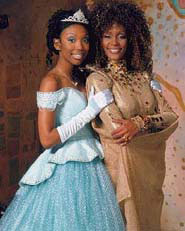
Whitney Houston and Brandy head an all-star cast that takes a new, interracial spin in the classic musical tale Cinderella.
In the television movie that airs November 2 on ABC-TV's "Wonderful World of Disney," Brandy plays the title role of a beautiful, lonely girl victimized by harsh sibling rivalry. Whitney Houston plays her thoughtful and imaginative fairy godmother. The film also marks Ms. Houston's debut as an executive producer. The movie was made under her Brown-House Productions Co.
The film also features Whoopi Goldberg as Queen Constantina, the Prince's mother who wants nothing but happiness for her son. Theater veteran Victor Garber plays her husband, King Maximilian. Veteran stage and film actress/singer Bernadette Peters bullies and belittles Cinderella in her role as the domineering stepmother. "Seinfeld" co-star Jason Alexander plays Lionel, the Prince's friend and loyal valet. Newcomer Paolo Montalban plays the Prince. Natalie Desselle and Veanne Cox are the stepsisters.
Brandy, who also stars in the television sitcom "Moesha," told Jet: "It was the best experience I could ever have. Working with those pros was great! Whitney is my mentor. That's no secret. Whoopi told me things like how to stay in this business. She knows how I love my work. And Jason Alexander is so much fun. Bernadette Peters was great, too."
http://findarticles.com/p/articles/mi_m1355/is_n24_v92/ai_19956257/?tag=content;col1

Video: Leslie Ann Warren (1964)

TV Musical: Leslie Ann Warren (1964)

In 1965 CBS re-staged CINDERELLA, with Richard Rodgers serving as Executive Producer. While Joseph Schrank was brought in to revise the teleplay, the score remained intact, with the addition of a solo for the Prince, "Loneliness of Evening" (a ballad originally written for, and cut from, SOUTH PACIFIC in 1949).

The ’65 CINDERELLA featured a cast as remarkable as the original: Ginger Rogers and Walter Pidgeon played the King and Queen; OKLAHOMA!’s original Ado Annie, Celeste Holm, played the Fairy Godmother; Jo Van Fleet was the Stepmother with Pat Carroll and Barbara Ruick as her daughters; and Stuart Damon played the Prince. A young Broadway star-to-be, Lesley Ann Warren, played Cinderella. Taped for broadcast, this CINDERELLA premiered on February 22, 1965, and was shown on CBS eight more times through February of 1974.